by Rahayu Rizky, PhD Student in Education Policy, Universitas Islam Internasional Indonesia
As soon as the Program for International Student Assessment (PISA) results are published, Indonesia is often asking the same question over and over again: did we go up or did we go down?
The question is understandable and communicates the intended point very clearly. PISA has grown to be a significant global standard for educational systems nowadays. The results give the government officials and policymakers information about how effectively students are actually performing in school and how their educational systems compare toward other country. But the most crucial question is probably: What does “improvement” really mean?
The PISA 2025 scores for Indonesia show slightly different results in all subject areas. Reading improved from 359 to 365, while science has risen from 383 in 2022 to 389 in 2025. There was a minor decrease in mathematics, from 366 to 364. However, the OECD says that the changes were not considered as statistically significant.
A further substantial progress related to educational accessibility along with participation in the PISA 2025 assessment. The PISA Coverage Index for Indonesia, which measures a percentage of 15-year-olds in the formal education system, had risen from 0.46 in 2003 to 0.90 in 2025. The Ministry of Primary and Secondary Education has highlighted the growth of educational access in accordance with relatively consistent learning outcomes. Educational progress is heavily influenced by both access and learning outcomes as the key aspects. But neither of these factors should be seen as sufficient enough to evaluate the overall condition of the education system or decide what kind of policies should be prioritized in the future.
PISA Is a System Question
Many people see PISA as a simple ranking exercise and the comparison between countries is made mostly as the basis of their scores. However, the assessment has been developed to analyze much more than relative performance. PISA examines whether 15-year-old students are able to solve issues, think more critically, communicate clearly, and apply what they have learned to the practical problem and also real-world situations.
Furthermore, this makes PISA more than an assessment of student performance. In this context, it also makes PISA as a policy question because the results open up the larger concerns regarding the design, implementation, and development of each educational system.
Then AI Changed the Question
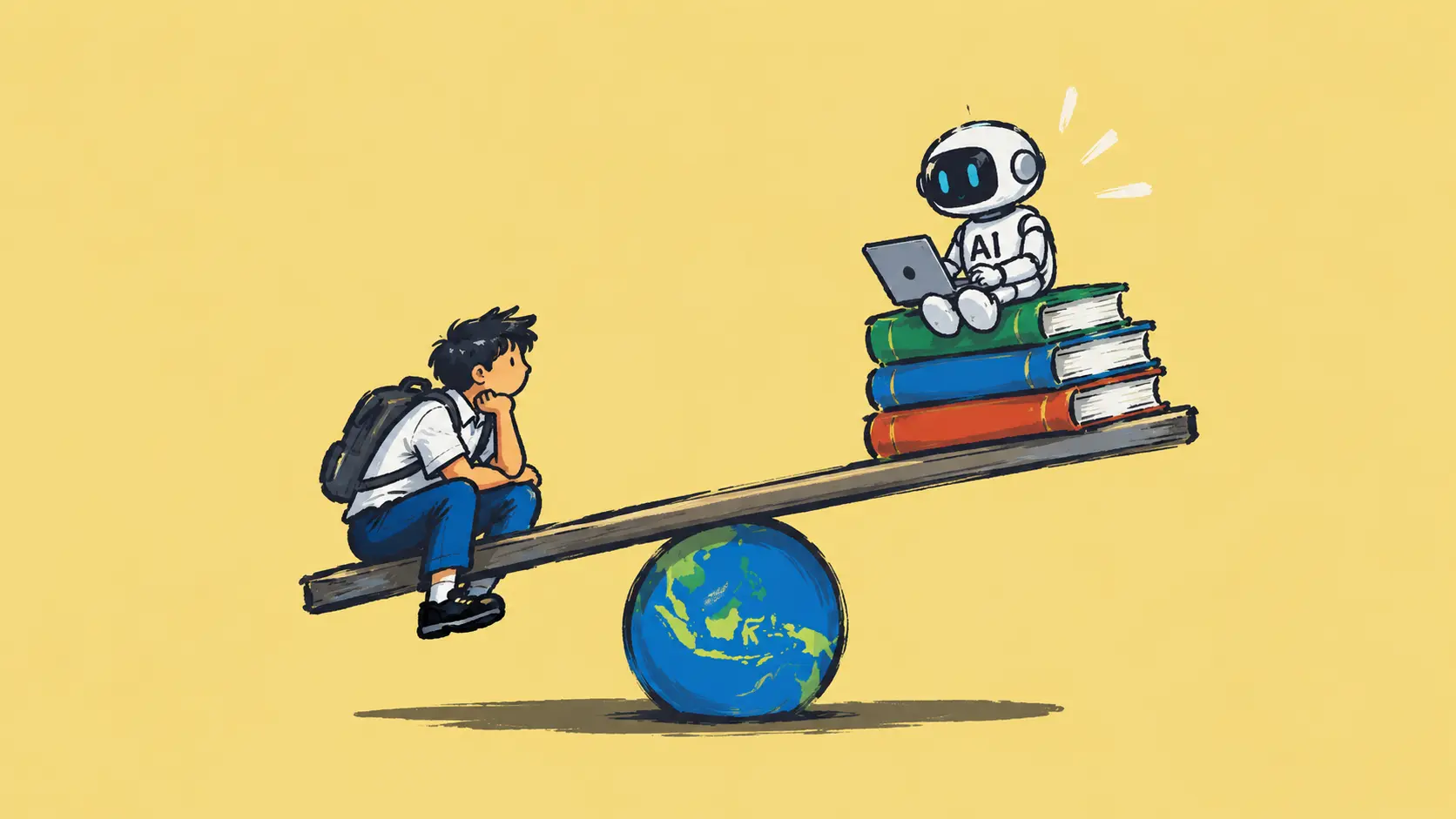
In the modern era of generative Artificial Intelligence (AI), the definition of educational improvement is becoming more complex and complicated to measured.
PISA 2025 reports that 53 percent of students in Indonesia used AI chatbots to help them learn at least once a week. Compared with other 46 percent across OECD countries, Indonesian students reported using AI to summarize the texts, conduct preliminary research and also drafting the assignments.
This shifts the policy question from enhancing the quality of student performance to the formal definition of how education systems support and measure the meaningful learning in the era of modern AI.
PISA’s findings present a critical warning against oversimplified conclusions. The connection between AI use and student achievement seems to be conditional depending on the actual use of AI. Students that utilize AI in order to finish certain specific academic tasks are likely to perform significantly worse than non-users. On the other hand, students who use AI for general learning in moderation are doing about the same as students who don’t use AI. The OECD furthermore highlights that these assessment’s results are needed to be view only as statistical correlations rather than the causality evidence. There is no specific evidence that using AI will affects student’s directly on their performance because other factors may also have an effect on the outcomes that are seen.
This makes AI more of a policy issue rather than just a technology issue, especially when it comes to education. The question is not whether schools in Indonesia should exclude the use of AI from the classroom, but how they should carefully manage and accurately regulate how AI is utilized in ways that encourage meaningful learning for their students.
So, what should Indonesia do?
First, education reform in Indonesia needs to be focus more on the implementation layer, where national policies are transformed into everyday practices in classrooms and school’s environment. But policy design alone is unable to provide real change; the results of policies vary depending on how they are interpreted, adapted and implemented by teachers, school leaders and other actors in different learning environments.
Second, assessment needs to reinforce the learning we say we value. Generative AI can progressively do tasks that students have always been expected to complete on their own. Therefore, assessments should focus on student’s abilities of reasoning, critically assess information, apply their knowledge and reflect their own thinking rather than simply reproducing answers provided by AI.
Third, Indonesia needs an equitable approach to AI in education. This approach means to ensuring that the benefits of AI are not only limited to advantage students and schools with better access to the technology, infrastructure, and also digital skills. If these opportunities remain uneven and concentrated among this category, technological change could widen the existing educational inequalities. Furthermore, these policies should not be designed and expected simply to improve Indonesia’s position in the next PISA ranking. Instead, they should focus on strengthening the educational systems, practices, and school environments that shape student learning.
PISA can be very useful in this context, not as a goal for policy, but as a diagnostic tool to assess the effectiveness of the implementation in education system. PISA enables policymakers to look beyond the rankings, whether teachers receive the proper support, how assessments foster critical thinking and whether students have the equal access to technology.
Indonesia’s education challenge is therefore larger than its PISA ranking. It is about building an education system that capable of producing meaningful learning for students in a world where information is abundant, answers are cheap and artificial intelligence can perform many cognitive tasks on demand.
PISA can tell us where Indonesia stands. Education policy must determine what happens next. So, yes, PISA may give Indonesia reasons to talk about improvement. But the more important question remains: Are we improving the numbers or are we improving learning?